When working as a music composer, beat
maker, or orchestrator in the music industry during this digital age of
technology DAW’s
become second nature. Therefore, when you need a level of control at your
fingertips look no further than Apple’s Logic Pro
X. So, what is Logic Pro? Well it is a digital audio workstation that has an
enormous collection of plug-ins
and sounds, which can flesh out any musical idea conceivable. This DAW provides
the user with the ability to compose sounds from scratch, start with a sine
wave and transform it into an industry standard. This feat is accomplished with
the advanced options of the sequencer in Logic Pro that lets you record,
edit, and manipulate MIDI
performances any way imaginable. For that orchestrator in you instantly convert
MIDI data into notation within Logic Pro while still being able to edit notes extensively
with input options to enter the music manually. Music notation tools with a full
notation layout allowing instrument transposition, drum notation, and lyric
input, this feature also allows printing of sheet music. With all of these
defining features nothing else is needed in creating your next hit or single
with this DAW.
Digital based composers develop amazing
sounds but just how do they accomplish this without the use of actual
instruments and synthesizers. When thinking about creating that next big sound
for your project, consider checking out the
ultimate production suite. Komplete 9
Ultimate is a package that delivers the entire collection of Native Instruments
65 instruments and effects through Komplete.
This package encompasses a complete creative suite for audio production
featuring 16,000 sounds totaling at 370 GB all placed on a single dedicated
external hard drive, so no more massive disc installations. As an added bonus Komplete 9 Ultimate is the most
inexpensive way to obtain Native’s libraries saving over 80% on all 65
products, compared to buying them individually.
Have you ever wondered how
a digital based composer developed such amazing orchestral sounds without an
actual orchestra, while having access to those hard to find ethnic sounds from
instruments across the globe? Well the Complete Composers Collection 2 is
where the search should begin; EastWest is the resource to use for instruments
of the world at an industry level. Created by founder and producer Douglas
Rogers, EastWest is the number one
distributor of virtual instruments software with clientele such as renowned
composers Bryan Tyler, Danny Elfman, James Howard and John Powell. Complete Composers Collection 2 is composed
of 7 of EastWest virtual instruments,
and can have additional virtual instruments added at a discounted price. Choosing
the Complete Composers Collection 2
is the most inexpensive way to obtain some of EastWest’s Libraries at more than 70% off the individual virtual
instruments retail price. The standard medium for the Complete Composers Collection 2 is a 1TB external hard drive. Seeing
how versatile putting together your personal collection can be I chose to go
over the personal collection I gathered for the Complete Composers
Collection 2. My collection choice is as follows, Hollywood Strings Gold,
Hollywood Brass Gold,
Ra, Silk, Ministry of Rock 2, Stormdrum 2 Bundle, Symphonic Choirs Bundle,
Voices of Passion, and Symphonic Orchestra Gold.
Self-publishing
is becoming a popular market amongst the independent professional community. Print-on-demand
(POD) and aggregator websites have become vast over this past decade. Self-publishing
has its advantages over obtaining publishing deals the traditional way. As
visited before, to get a publishing deal the traditional way, a query
letter needs to be created to obtain an agent. Once
the agent is attained, a press
kit must be created to
showcase your identity as an artist, something like a resume. This will allow
an agent to shop your works to a publisher, in hopes of getting a publishing deal.
As for Self-publishing, it is possible to publish works without the involvement
of an established third-party. Self-publishing forwards the author
responsibility and control over the entire publishing process. This process
includes design, file formats, price, distribution channels, marketing and
public relations. The author can either do it all themselves, or outsource the
process to companies that offer these services.
On the
road to finding a reputable publisher, there are steps that must be taken in order to reach those reputable
publishers. First lets state that the entertainment industry is all about the
connections you have and what you know. As a rookie music composer ready to
attempt at finding opportunities in the music industry, a certain connection is
needed to mediate between the publisher and us. Most production companies will
instantly refuse to review unsolicited works, which most likely will be thrown
in the trash once received. Getting to the first step at finding a publisher,
find a reputable agent that best thrives in your field of
choice and at your skill level. An agent is the go between that can
successfully solicit works to production companies. Agents have those vital
connections to the industry that is needed to get to that next level.
Novels
made into film adaptations
have become the go to means of producing for new films in the entertainment
industry. Film adaptations of novels have led to many legal disputes over the
years. These disputes are based on if copyrights are still protected or are the
works in the public domain,
due to the works dating prior
to 1923. Adding to this heated dispute lets add some more fuel to the fire by
reviewing some of these cases in detail. There are a lot of works out there in
the entertainment market related to the character Sherlock Holmes. Works such
as feature length films and the TV show Elementary, which is based current day
in New York City. What
most people don’t know is that the character Sherlock
Holmes was first introduced in 1887 and was featured in four short novels
and 56 short stories dating from 1887 to 1927. The question that is constantly
disputed is whether Sherlock Holmes is in the public domain or not. Based on
changes to our US copyright
act everything prior to 1923 is in the public domain, which is where most
of the confusion stems from with the character Sherlock Holmes. With that being
said, the characters Sherlock Holmes and his sidekick Dr. Watson’s relationship
on what they did and how they worked together were created prior to 1923.
However, the estate of Sir Arthur Conan Doyle, is saying
between 1923 and 1927 versions of the Sherlock Holmes story, are being featured
in the current book scheduled for publication by random house.
In recent news the court system has been
receiving their run of industry court lawsuits. Today lets narrow in on a few
of these cases, preferably ones dealing with and affecting the entertainment
industry. The European
Court of Human Rights has supported the conviction on one of the world's
largest sharing torrent file websites, Fredrik
Neij, and Peter Sunde Kolmisoppi,
two of the co-founders of The Pirate Bay. Neij and Kolmisoppi were both charged with Connivance to commit crimes in
violation of the Copyright Act. Their sentence was for one years incarceration
and a 3.3 million euros (4.3 million US) fine. This sentence was later reduced
but the fine was raised to 5 million euros (6.5 million US). Neij and Kolmisoppi then filed an application arguing
that under Pirate Bay they received and provided information to Internet users about
torrent files, which led them to believe that liability for IP infringement
fell on Pirate Bay’s users. They
both believed their right to communicate information was protected by Article
10 of the European
Convention of Human Rights, which dictates that everyone has the right to
freedom of expression. This right also includes the right to embrace opinions,
receive and convey information and ideas without restriction by public
authority, regardless of borderlines. What Neij and Kolmisoppi didn’t take into account is that the same article also states
that this shall not prevent States from requiring the licensing of
broadcasting, television or cinema enterprises. The ruling says, (Eriq
Gardner, 2013) "Since the Swedish authorities were under an obligation
to protect the plaintiffs’ property rights in accordance with the Copyright Act
and the Convention, the Court finds that there were weighty reasons for the
restriction of the applicants’ freedom of expression."
Once an afterthought in terms
of game design and overall music culture awareness, video game music is now an authentic
industry of its own. Today, worldwide prominent orchestras perform concerts of
music composed specifically for video games and features top of the line film
composer soundtracks. Like
the purpose of all great scored music, it's supposed to appeal to your
heartstrings and drive your emotions wild. Video game music has become over
this past decade so indistinguishable from scored music for films, that many have begun to
envision a video game to be on the same level as a feature length film. In the
past video game music was limited by its hardware but that all changed with the
introduction of the CD-ROM.
Furthermore, the National Academy of Recording Arts
and Sciences (NARAS)
decided in the year 2000 to let interactive games compete in the annual Grammy
awards.
You have to ask yourself, if performing artist’s
use artist
managers, what can an artist manager do for a music composer. Essentially
promotion will be the focus in managing a composer. Due to artist
managers working with various clients they have the contacts to Send your
music out, talk to directors about your music catalog and look for commission
project opportunities.
However, for a composer like myself I prefer to employ an artist manager to
handle the business aspect of my career. This will allow me to focus on the
creative process, which is the music. There comes a point in a composer’s
career when they know that they cannot push their skills as hard as somebody
like a manager can push. When a music composer feels overwhelmed by the amount
of project details and has countless commitments in a short period of time, in
my opinion is where an artist manager can place their worth.
William Ury’s Negotiating for Sustainable
Agreements presentation discusses the strategies he has developed at the Harvard Negotiation
Project for creating sustainable agreements in diplomacy and business. Ury discusses
how much time we already dedicate to negotiation in our everyday lives. Conflict
has been suppressed over the years and is now coming to the surface. We have a
choice to resolve conflict through family feuds, lawsuits, and wars. Or we can deal
with conflicts constructively through listening, dialogue, collaborative
problem solving and non-violent actions. You can learn from Ury’s presentation
that objective
criteria can be used in more ways than just preventing wills from clashing. Using
a third side to way in concerns for both parties can also use objective
criteria to express concerns in a negotiation that can benefit all negotiators.
Learning not to react and gaining the ability to listen will take any negotiation
to the next level. This allows you to focus on interest and not positions to
learn what is wanted and better assess the direction of a negotiation. 
Composer Brian Tyler is best
known for his beautiful musical pieces of cinematic orchestral scoring, melded
with a groove and contemporary style. Brian has composed for over fifty
films and was recently nominated for the
Film Composer of the Year award by the International Film Music Critics
Association. Lets focus on a movie that score stands out with the use of
Brian’s groovy cinematic style of
composing. Fast Five was a hit at the box office and part of that is due to Brian’s
Hollywood cinematic scoring. Fast Five score was built on a combination of
groove music and contemporary music. These genres of music usually don’t go
together but Brian Tyler orchestrated these styles together beautifully.
The
current release of The Hobbit film has brought fans back into the
world of Middle Earth. With that in mind lets re-imagine the musical scores of
The Lord Of The Rings trilogy. Howard Shore may have composed for over more than
60 films, his greatest work would have to be his Oscar and Grammy awarded
work on The Lord Of The Rings trilogy. The arrangement of the score is rather
massive, shore stated on Runmovies.eu. He had to unearth the music; He
didn’t just theorize what it was. Four months of research was done before he
even wrote a single note. Therefore, he had to discover and immerse himself in
the history. The mythology of the Ring has been around for millennia, so
mirroring the fantasy world concept of where The Lord Of The Rings comes from
was quite a feat.
The MPAA is an abbreviation for the Motion Picture
Association Of America; aside from its name what do we know about this company.
Well the MPAA is the support and voice of motion picture and
television industries in the United States. MPAA’s members consist of the six
major US studios for motion picture. Those six motion picture studios are as
follows: Walt Disney, Paramount, Sony, Twentieth
Century Fox, Universal, and Warner
Bros. The MPAA prides themselves in the protection of property rights, free
and fair trade, groundbreaking consumer choices and freedom of speech to enrich
and empower movies.
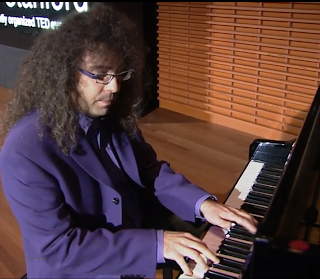
TED speakers seem to
always have intriguing ways of speaking to an audience and keeping them
engaged. Mark Applebaum’s TED talk breaks the rules of composing in
eccentric ways. Mark’s talk is based around the concept of music steadily
becoming boring and how a different approach can make it more interesting. Mark
inspires his audience with comedic jokes to keep them engaged in the talk. He
also uses visual examples to show the audience what he is talking about, which
helps to support his theories on boredom and music. (Mark Applebaum 2012) “Is
it music? … This is not the important question. The important question is, is
it interesting?” (p. 1) Mark’s view on making music more engaging has
pushed him to do projects such as the metaphysics of notation.
When you hear the name Daft Punk, the first thing you think of is decades of amazing electronic music. Well think again, French producers Guy-Manuel de Homem-Christo and Thomas Bangalter has touched new ground with their roles as film score composers for the movie Tron Legacy. Coming from producing electronic music in a small bedroom to having their music performed by a 90-piece orchestra has proved to be an intense and challenging experience for the French Duo.

The sounds that transformers
make are astonishing; sometimes it’s hard to believe that transformers are
fictional characters. Hearing those transforming sounds just
sound authentic as if that’s how they would sound if they were real beings. So
the question is how do sound designers engineer such believable sounds to fit
these massive robotic beings. Well in an
interview with Erik
Aadahl on Designing
Sound he explains how those unique sounds make it to the big screen. The
transforming sound is an iconic brand for the Transformers franchise. The
original Transformers
cartoon featured a rising or falling 5 beat splatty pitch rhythm sound,
which can be created through using Polyphonic synthesis. To recreate that basic
transforming sound you would need a 500 Hz tone, adding a flanger plug-in to adjust the rate and create the splatty sound. Then you need to automate a pitch rise
from start to finish ramping up the tone, adding a tremolo pattern, and tweaking
that to get the 5-part rhythm. That’s basically how the original cartoon
transforming sound was created.
Hans Zimmer built a reputation on his electronic sound and quality in scoring for film. Hans's work can be heard through the bass, piano, guitar and synth modulation in the film Inception. When hearing the Inception score for the first time you can’t help but feel the emotions of the characters coming from the music. First, you hear that love is the premise of the scoring, then you also hear this dark ambient feeling. On the technical aspect of the score you recognize these huge orchestral scores layered perfectly with rock guitars. When hearing music in films breaking barriers such as the Inception score, it just makes you think how something like this came into being.
After doing extensive research about the Performance Rights Act, I decided to do my discussion on an article I found called “H.R. 848, The Performance Rights Act: The Recording Industry’s Saving Grace?” by author Nyasha Shani Foy from New York Law School. February 2009 Congressman John Conyers, Jr introduced H.R. 848, The Performance Rights Act in the U.S. House of Representatives. This law proposes to expand copyright protection for sound recordings and require Analog and AM, FM radio stations to pay for the use of sound recordings. If enforced H.R. 848 will deliver another source of revenue for copyright holders, musicians, and performers.
Nyasha’s position on the bill is of a neutral nature, Nyasha states in her conclusion that HR 848 is not a perfect solution. She goes on to say the legislation demonstrates the congress commitment to intellectual property issues. In addition she states that regardless of what happens the HR 848 will remain an important piece of legislation for all IP industry professionals. Nyasha’s position of the bill was well thought out and researched. Reading the bill you can see ripple effects that can happen if the bill is passed, thus showing just how imperfect the bill really is. As Nyasha said congress shows their dedication to IP issues in hopes of strengthening our country. A profound review and edit of this bill will make the HR848 become more realized. Regardless of the outcome, many parties will remember the IP HR848 bill.
Article 1, Section 8 of the U.S. Constitution states that The Congress shall have power to promote the progress of science and useful arts, by securing for limited times to authors and inventors the exclusive right to their respective writings and discoveries. In Short Copyright Law gives an author the right to register a copyright when a work is fixed in a tangible form for the first time. Exclusive rights also give the author the right to reproduce, perform, display, derive, and distribute works. In addition it gives the author the right to give others a license to exercise those rights.

Dr.Dre born Andre Young is an American rapper, record producer, entrepreneur and founder of Aftermath Entertainment. Dre has produced and molded the careers of many artists in the industry. As a producer he is recognized as a major figure in the popularization of West Coast G-funk, a sub-genre of rap music considered as synthesizer-based with slow, heavy beats. Dre road to fame in the music industry started as a member of World Class Wreckin’ Cru, Later finding fame with gangsta rap group N.W.A, popularizing the usage of explicit lyrics in rap music detailing the violence of street life. While with N.W.A Dre melded the styles of Bomb Squad with funky rhythms; reworking George Clintons elastic funk in creating G-funk, which relies on sound rather than content. Dre left N.W.A in 1992; later credited to Co-founding Death Row Records with music partner Suge Knight. Dre released his solo album The Chronic and won a Grammy Award for the single Let Me Ride becoming one of the best-selling American performing artists of 1993. For the next four years Dre’sG-funk style was used all through the hip-hop industry.
Subscribe to:
Posts (Atom)
Follow
Subscribe
Contact
Popular Posts
-
Hans Zimmer: The Inception Score, World of Dreams and Time
-
Native Instruments The Ultimate Production Suite
-
The Magnum Opus Of EastWest
-
Logic Pro Cranked Up To X
-
Mark Applebaum: The mad scientist of music
-
Transformers Sound: Autobots Roll Out
-
Brian Tyler Fast And Furious With Groove
-
The Velvet Underground & Nico
-
Electronic Music Kraftwerk
-
The Traditional Way To A Publisher
Blog Archive
Powered by Blogger.